Plush fabrics and fibre labels
A soft surface does not identify a fibre. Compare the fabric name, fibre content, weight and pile before you choose material for a plush build.
Use the calculator to compare fabric weights in different units. Then check what the supplier actually states about the cloth.
Minky, velboa, faux fur, fleece or cotton?
These names do not describe the same property. Cotton names a fibre. Minky, velboa and fleece describe kinds of fabric. Faux fur describes a fur-like material. Check the specific fabric specification instead of treating a familiar name as a complete composition label.
- Minky: Shannon Fabrics lists its Cuddle 3 minky as 100% polyester with a 3 mm pile. Its FAQ, checked in 2026, also describes higher-pile and lower-pile versions. That specification belongs to that fabric, not every minky.
- Velboa: Fabric Base describes its velboa as short-pile faux fur made from 100% polyester. Its fabric guide, checked in 2026, gives a useful example. Request the composition for the fabric you plan to use.
- Faux fur: Shannon Fabrics’ 2019 guide describes synthetic knitted fabrics with different weights and pile heights. Acrylic and polyester can occur together. The word “faux” alone does not give their proportions.
- Fleece: Polartec describes its Fleece Series as a synthetic knit with raised pile. Its product page, checked in 2026, states that most of its fleece uses recycled polyester. Do not extend that claim to every fleece.
- Cotton: Cotton is a plant fibre. USDA’s Cotton Sector at a Glance, checked in 2026, describes separating cotton fibres from seeds. A fabric can contain cotton alone or a blend. Read its percentages rather than judging by touch.
Pile height and fabric weight answer different questions
Pile is the raised surface above the fabric backing. Shannon Fabrics’ 2019 faux-fur guide describes pile height as the length of those fibres. A pile measurement does not state fabric mass. Compare both measurements when you assess samples.
Ask for a swatch. Check its surface direction, backing, stretch and care instructions. Make a trial seam with your intended pattern. Keep the supplier’s specification with the sample so you can identify the material later.
Fabric weight converter and estimator
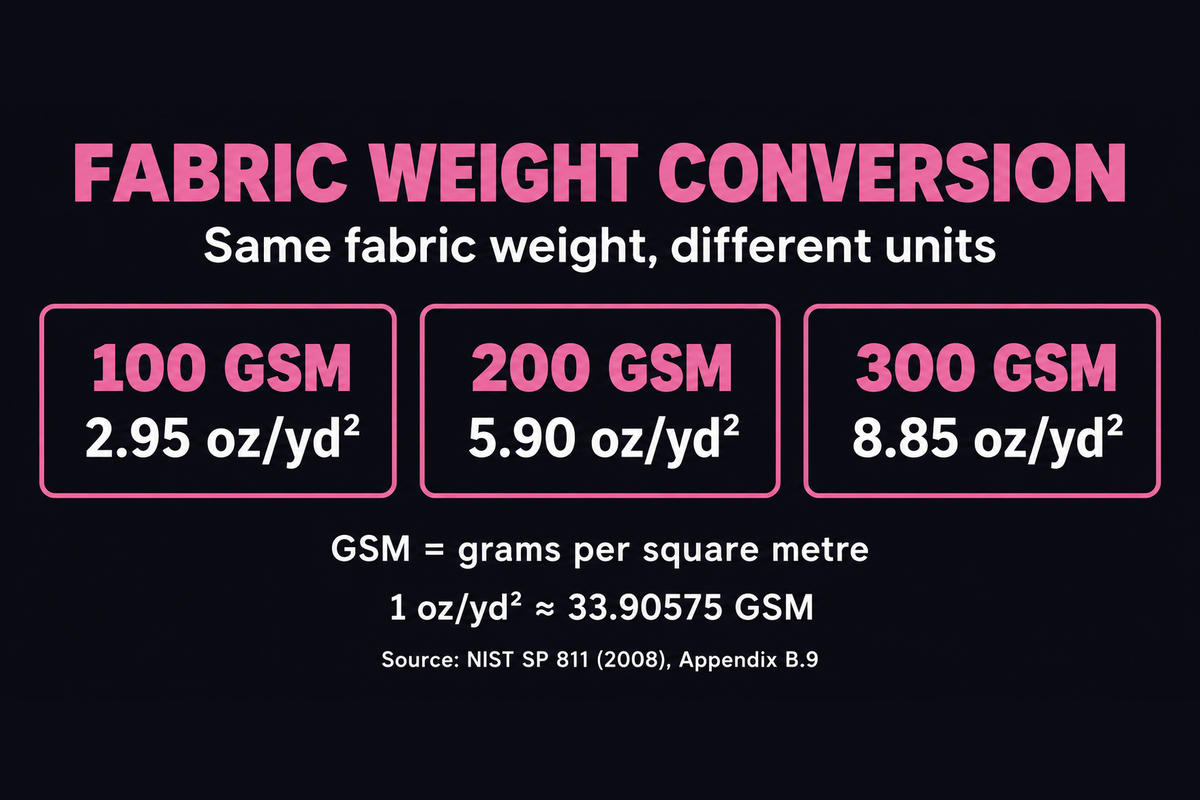
GSM means grams per square metre. Ounces per square yard, written oz/yd², also measure mass per area. Neither unit tells you the weight of a whole roll without its area.
Enter the stated fabric weight. Enter the width and length of a rectangle containing your pattern pieces, including cutting gaps and seam allowances.
Method: NIST SP 811 (2008), Appendix B.9 gives 1 oz/yd² ≈ 33.90575 GSM. Divide GSM by 33.90575 to get oz/yd². Multiply oz/yd² by 33.90575 to get GSM. Area in m² = width in metres × length in metres. Fabric mass in grams = GSM × area.
Example inputs: 300 GSM over 50 × 40 cm give 0.20 m² and 60 g. This estimates the rectangular fabric piece, including offcuts. It excludes stuffing, thread, eyes and other parts. It does not predict the finished toy’s weight. Calculate different fabrics separately and add their masses. Results use unrounded values internally.
US fibre labels: check the product category
The Federal Trade Commission (FTC) explains the Textile Fiber Products Identification Act in Threading Your Way Through the Labeling Requirements. Its guide, updated in 2025, distinguishes covered fabrics and cushions from excluded toys.
For covered products, labels generally need fibre content, country of origin and the responsible business name or registered identification number. Generic fibre names and percentages by weight appear in descending order. A fabric name such as minky does not replace a fibre name such as polyester.
Fibres below 5% generally appear as “other fiber” or “other fibers.” Exceptions include wool and fibres with a definite functional significance. Consult the FTC guide for the applicable details.
Do not assume every plush item needs the same label. The FTC guide excludes textiles used in toys from the Textile Act requirements. Separate toy safety rules and state requirements can still apply.
Sources: FTC textile guide (2025 update); CPSC Toy Safety Business Guidance and Pennsylvania Department of Labor & Industry, Stuffed Toys (checked 2026).